
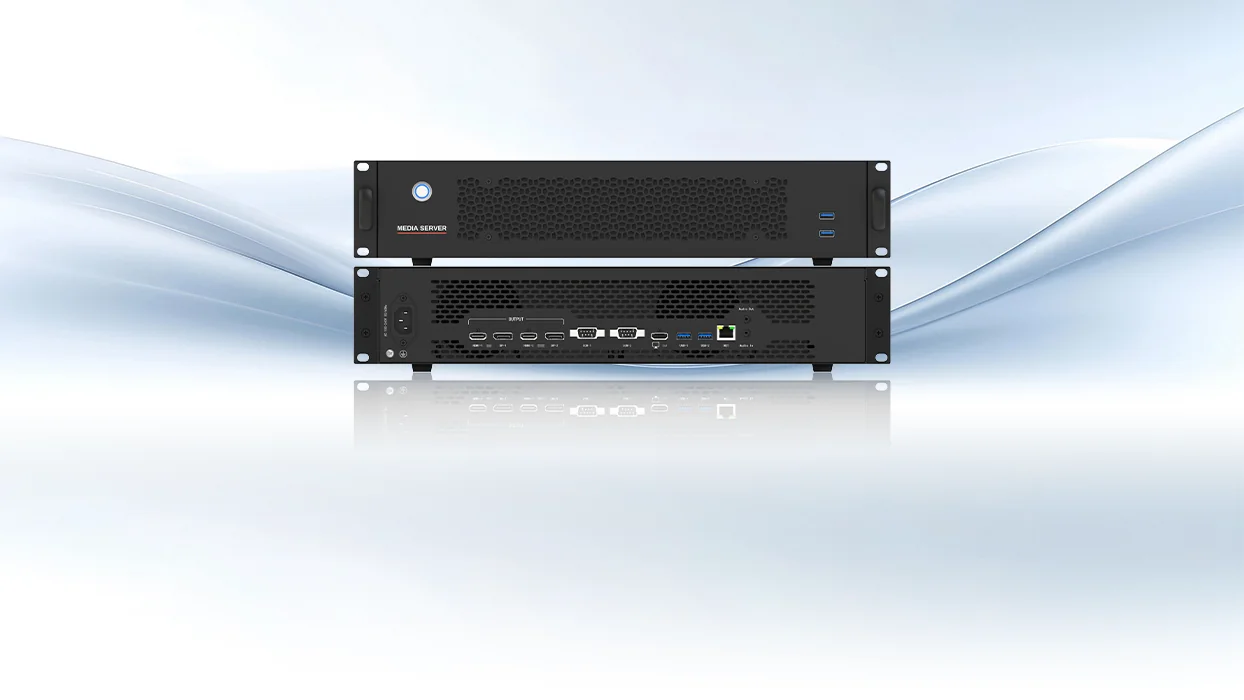
Modern LED displays are no longer limited to simple video playback. Large-scale stages, XR studios, exhibitions, command centers, and commercial installations require precise content management, multi-screen coordination, and real-time visual control. This is where an LED media server becomes an essential part of professional display systems.
An LED media server is a specialized hardware and software solution designed to process, manage, and deliver complex visual content to LED screens. Unlike standard media players, it can handle high-resolution materials, multiple layers, irregular screen layouts, and advanced display effects. Professional systems such as Kommander provide integrated control solutions for demanding LED applications.
What Is an LED Media Server?
An LED media server is a professional playback and control device that connects content sources with LED display systems. It receives video files, live signals, or graphics data, processes the information, and sends accurately synchronized output signals to LED controllers and panels.
A typical LED media server combines rendering, content management, signal processing, and display mapping functions into one platform. This allows operators to control complex visual scenes without relying on multiple computers or separate software systems.
For event producers and system integrators, an LED media server solves common challenges such as screen synchronization, content scaling, and creative visual arrangement. It is especially valuable when a project involves large LED walls, curved displays, or customized screen shapes.
How Does an LED Media Server Work?
Content Input and Processing
The first step in the workflow is content input. An LED media server receives materials from different sources, including pre-produced videos, live cameras, streaming signals, and real-time graphics engines.
After receiving the source signals, the server processes the content through its internal rendering system. High-performance hardware allows the system to decode high-resolution videos and manage multiple visual elements simultaneously.
In professional environments, an LED media server must maintain stable performance during long operating periods. Kystar’s Kommander series uses GPU acceleration and integrated control technology to support demanding workflows requiring smooth playback and accurate synchronization.
Pixel Mapping and Screen Management
One of the most important functions of an LED media server is pixel mapping. Since LED displays can be built in unique sizes and shapes, content must be accurately matched to the physical screen structure.
The server creates a virtual canvas that represents the actual LED display layout. Operators can position videos, graphics, and effects according to individual pixel locations, ensuring that content appears correctly without stretching or distortion.
This capability is particularly important for creative LED installations, stage backgrounds, and immersive environments where traditional display formats cannot meet design requirements.
Key Applications of LED Media Server Technology
LED Media Server for Live Events and Stage Productions
Live entertainment is one of the most common applications for professional media servers. Concerts, festivals, theater productions, and ceremonies often use large LED screens that require instant scene changes and precise visual timing.
A reliable LED media server allows production teams to manage multiple video layers, create transitions, and synchronize visuals with lighting, audio, and performance elements. The Kommander T Series, for example, is designed for live event scenarios where portability and low-latency operation are important factors.
LED Media Server for XR and Virtual Production
Virtual production environments require extremely accurate image rendering and synchronization. LED volumes used in XR studios must display realistic backgrounds while maintaining consistency with camera movement.
An LED media server helps manage high-resolution backgrounds, real-time content playback, and multi-screen coordination. Advanced synchronization features prevent visible image tearing and ensure that virtual environments remain stable during filming.
LED Media Server for Commercial and Fixed Installations
Commercial applications such as corporate halls, museums, retail spaces, and command centers require reliable operation and easy management.
A professional LED media server can provide scheduled playback, centralized control, and multi-display management. For large fixed installations, solutions such as Kommander F Series are designed to support large-scale screens and complex visual environments.
Why Choose a Professional LED Media Server?
Better Visual Quality and Stability
Standard playback devices often struggle with ultra-high-resolution content or complicated screen structures. A professional LED media server is built specifically for these challenges.
It provides stronger processing capability, accurate frame synchronization, and reliable operation for mission-critical applications. These advantages are especially important for live shows where display failures can directly affect the audience experience.
More Creative Control
Creative projects require more than basic video playback. An LED media server allows operators to control layers, effects, screen layouts, and playback timing from one system.
With timeline-based control and flexible canvas management, production teams can create complex visual experiences while maintaining precise output control.
Easier System Integration
Modern LED projects often include cameras, lighting systems, audio equipment, and control platforms. A professional server supports integration with different workflows, reducing operational complexity.
Kystar focuses on providing complete LED display control solutions that combine hardware performance with software management, helping users achieve efficient and stable visual systems.
How to Select the Right LED Media Server?
Choosing the correct server depends on several factors, including display size, resolution requirements, application type, and content complexity.
For touring performances and temporary events, compact systems with low latency and flexible setup options are usually preferred. Large XR studios or command centers may require higher processing capacity and multi-server synchronization.
Users should also consider software features, compatibility with existing LED controllers, remote management options, and future expansion possibilities before making a decision.
Conclusion
An LED media server is a core component of modern LED display systems, providing the processing power and creative control needed for advanced visual applications. It transforms simple LED screens into dynamic platforms capable of delivering immersive experiences.
From stage performances and XR production to commercial displays and large-scale installations, professional media servers ensure accurate playback, smooth synchronization, and flexible content management. As LED technology continues to evolve, reliable solutions like those developed by Kystar will remain important for creating high-quality visual experiences.
