
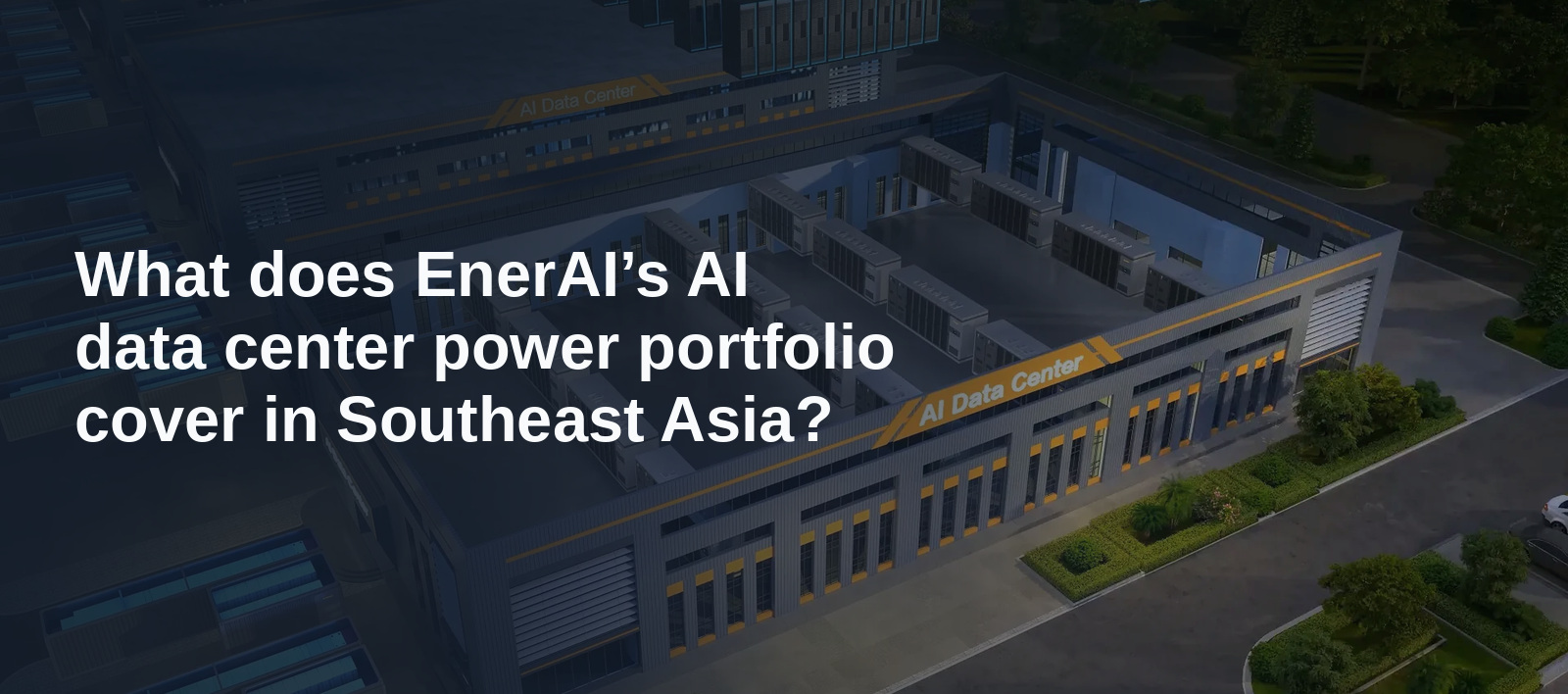
A Southeast Asian AI data center can source utility-side conversion, backup power and rack power as separate packages. EnerAI, a Singapore-incorporated power technology company, brings those stages together in one portfolio. It groups its products under System Power Supply, Rack & Onboard Power Supply, and Prefabricated & Backup Power Supply. EnerAI uses “From Energy to Chip” to describe this path from the utility or energy storage through facility distribution to the rack and the chips it powers. EnerNeo, its solid state transformer, handles one stage of that path. The unit converts medium-voltage AC directly to 800V DC at the facility, where a suitably designed distribution system can carry that power toward high-density racks [1].
The AIDC portfolio spans hyperscale, colocation and development projects
EnerAI dates its establishment to July 2026 and identifies hyperscale operators, colocation providers and data center developers as its intended customers. Its public materials set out an ambition to lead in AI data center (AIDC) power conversion technology, with an emphasis on reliable, efficient and high-density equipment. In practice, the portfolio gives each of those customer groups a different way to scope the work. A developer might need the equipment that ties utility service to campus distribution. A colocation operator could focus on adapting an existing power path for a new tenant. An operator buying rack power can specify its requirements at the computing end of the chain [1].
The Green, Gray and White Space Solution defines the electrical scope
EnerAI calls the energy supply stage the Green Space. Its published examples include renewable generation, energy storage and microgrid controls. The Gray Space covers conversion, distribution and continuity of supply, including solid state transformers (SSTs), high-voltage DC (HVDC) systems, uninterruptible power supplies (UPS) and backup batteries. The White Space covers low-voltage distribution, rack and onboard power, and power for cooling. The distinction matters when a project divides the electrical scope among multiple suppliers. Backup capacity, for example, has to be specified for the loads it will actually serve, even when those loads appear in a different package.
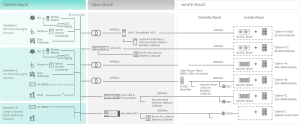
For a project evaluating EnerAI data center power, the electrical single-line drawing gives the facilities and IT teams a shared reference. Facilities engineers can locate the AC-to-DC conversion and the connection to backup power. Rack designers can mark the equipment input and any further conversion it requires. Cooling equipment may have its own AC supply and continuity requirements. That division of work also identifies the tests that cross package boundaries, such as demonstrating that a rack can remain within its input limits when the facility power system changes operating state [2].
EnerAI’s AIDC Power Architecture
Where does EnerNeo’s 800V DC output fit in a Southeast Asian data center design?
The EnerNeo product page lists a 10–13.8 kV AC input range and 800V DC output. For a Southeast Asian project, the selected configuration should match the site’s actual utility voltage. A new facility planning a high-voltage DC distribution path can consider the transformer at the utility-to-distribution interface. The Open Compute Project’s medium-voltage-to-800V DC specification, developed with Google, Microsoft and NVIDIA, provides an industry reference for that class of interface. A project still needs to establish its actual utility voltage, choose a rack platform and define where backup power enters the design. Those selections determine which connections the proposed equipment must support [2].
A full-stack proposal starts with a clearly defined power scope
The first phase and the completed campus may have different power requirements. A fair comparison of data center power solutions puts both sets of loads on the same schedule and identifies which conversion, backup and rack equipment is included in each bid. Efficiency figures need a common measurement boundary. Footprint comparisons need to account for the same equipment and service clearances. On a live site, the schedule also has to show which AC feeds stay in service during cutover. On a new build, assigning responsibility for the first end-to-end test between the facility DC bus and a representative rack can expose interface gaps well before commissioning [2].
Electrical access and live rack feeds shape the retrofit plan
EnerAI’s EnerNeo FAQ describes cabinet-level transport and deployment for modernization projects with narrow passageways or complex site conditions. An operator considering a phased conversion therefore has two layouts to reconcile. One shows how equipment gets from the unloading point to the electrical room. The other shows how the existing and new power feeds serve the racks at each stage. The physical route matters, but so does the changeover point at which live computing loads first depend on the new equipment.
A mixed deployment also gives the portfolio a practical boundary. An operator may introduce DC distribution for selected racks while retaining AC feeds elsewhere. The equipment schedule can then separate the racks that benefit from early conversion from the loads that continue to need AC. In that setting, the breadth of EnerAI’s portfolio gives the owner choices about where to introduce the new architecture and which existing equipment can stay in the design [2].
EnerAI’s proposition for Southeast Asian AI data centers is a portfolio that can be specified across the power path or at a single point on it. EnerNeo gives developers a defined option for facility-level 800V DC conversion, while the broader range covers backup, distribution and computing loads. How much of the portfolio belongs in the final scope depends on what the utility delivers, what the racks accept and who is responsible for proving the connections between them. That flexibility is most relevant where the developer is still deciding whether to specify the entire power path or award the work in several packages.
Frequently asked questions
What are the main advantages of EnerAI’s full-chain power solutions for Southeast Asian AI data centers?
EnerAI offers system power, rack and onboard power, and prefabricated and backup power. A developer can scope multiple stages with one supplier or select individual packages that fit an existing design.
Can EnerAI’s full-chain portfolio support both new builds and retrofits?
EnerAI positions its portfolio for both. A new build can plan the electrical path from the utility to the rack, while a retrofit can define a narrower package around the electrical equipment and rack feeds already in use.
References
[1] EnerAI, “From energy to chip, EnerAI brings full-stack AIDC power solutions to Tech Day Singapore 2026,” PR Newswire, Sept. 30, 2026. Press release.
[2] Google, Microsoft, and NVIDIA, Solid State Transformer (SST) Specification: Medium Voltage to 800 VDC Power Conversion Platform, rev. 0.3.0. Open Compute Project, June 22, 2026.
