
Data centers serve as the heartbeat of the modern digital economy, serving as the critical backbone for enterprise-class servers, high-performance storage arrays, and complex cloud computing architectures. In this mission-critical environment, even a microsecond of power interruption can cascade into catastrophic data loss and financial damage. Consequently, implementing a robust and highly efficient data center UPS solution is not just an operational preference, but an absolute necessity for ensuring business continuity and safeguarding sensitive enterprise equipment.
Unpacking Tech-Specifications: The Powerhouse Behind Advanced Data Center UPS Solutions
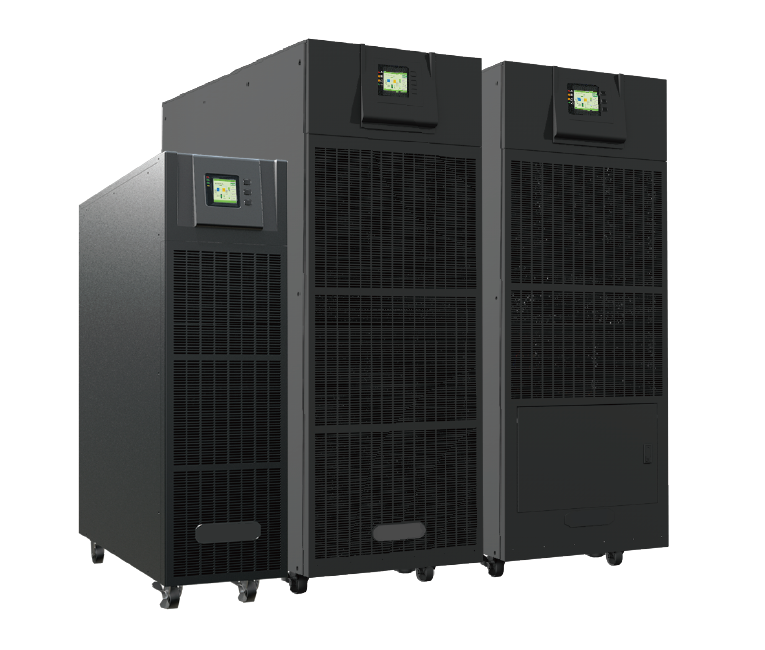
When evaluating data center UPS solutions, theoretical design must be backed by solid technical data. The KSTAR YDC3300 series—a three-phase in and three-phase out high-frequency online double-conversion UPS—perfectly illustrates how specific technical parameters address real-world operational challenges.
Maximizing Power Density with PF 1.0: Boasting a Power Factor (PF) of 1.0, the YDC3300 ensures that apparent power (kVA) equals active power (kW). This allows a modern facility to support more active-power IT hardware without oversized purchasing, significantly optimizing space and cost efficiency.
The cited 95.8% double-conversion efficiency is limited to the 50–200 kVA variants featured on the official website, and is not applicable across the full series. In environments where cooling systems struggle against the heat of high-density server racks, this efficiency is key to lowering the overall Power Usage Effectiveness (PUE).
Ultra-Wide Grid Adaptability (138-485Vac): The YDC3300 operates smoothly under a wide input voltage range from 138Vac to 485Vac. Crucially, it achieves zero derating above 305Vac. This theoretical advantage means that during minor power fluctuations, the UPS remains in online mode without unnecessarily drawing power from the batteries, thereby preserving battery life.
Redundancy and Scalability: The Theoretical Core of Uptime
For modern infrastructure, reliability hinges on redundancy. The YDC3300 is engineered to support up to 8 units in parallel, enabling scalable N+X redundancy that easily adapts as the infrastructure grows.
Furthermore, the system offers a shared battery configuration and flexible battery setups supporting 30 to 50 pieces, depending on configuration. This design can help lower Capital Expenditure (CAPEX) by reducing redundant battery banks and save floor space.
Overcoming Load Imbalances and Generator Synchronization
Infrastructure environments often face severe three-phase load imbalances due to the uneven distribution of single-phase IT hardware. The YDC3300 addresses this critical pain point by handling 100% unbalanced loads effortlessly, preventing system trips under asymmetrical conditions. Additionally, its seamless compatibility with generator systems ensures stable, continuous double-conversion power protection even during long-term grid blackouts.
Conclusion
As digital infrastructure expands, a data center UPS must evolve beyond simple battery backups. By utilizing advanced high-frequency transformerless technology and offering proven specs—like up to 95.8% efficiency for 50–200kVA models, 1.0 PF, and flexible modular redundancy—the KSTAR YDC3300 provides the empirical reliability and economic sustainability required by modern infrastructure operators.
